Saturday, March 16, 2013

Long Multiplication

Growing up in Canada, I was taught how to do long multiplication through columns and adding zeroes.  Since having the opportunity to teach over seas, I have learned a few tricks of the trades that not only make MUCH more sense but are quite simple and easily (they also take up less space on the page).

Long Multiplication:
When you are multiplying two larger numbers, we can actually make a chart that does the same thing as the columns and adding zeroes does.  This way, the students can see why we need to have extra zeroes on some numbers instead of just following the rule.  Here is how we lay out the question:

The students do need to know multiplication of multiples of ten (multiply the non-zero numbers together, then count the number of zeroes in each number and it them onto the end of the multiplication) and place values. 

I always instruct my students to think about the number of ones (digits/units), tens, hundreds and so forth when creating their chart. 

 
After creating the chart, all students need to do it multiply the numbers together and add all of the answers together.  By doing this, the students will be able to visualize what they are adding and what influences their answer the most. Here is the worked out example:

Monday, February 25, 2013

Different Worksheets

Yes! I have managed to do it - well partly.  I have managed to have the ability to make different leveled worksheets for my students.  There are two or three different worksheets for each level.  Most of the questions are the same; but then there are also different extension questions and additional challenge problems.

Most of my students responded greatly to this idea, many wanted more personalized worksheets that would allow them to all excel and practice what they need to practice.  Some of the weaker students did not mind and took the opportunity to complete their worksheet ot the best of their abilities in hope to move up.  And, if they continue this, they most definitely will!

My next step is to make sure that I am able to put different levels to these worksheets.  The topics for concepts this half term are not as flexible as the others, so this does pose a challenge - but I think I am ready for it!

Wednesday, February 6, 2013

Stress and De-stressing

Stress comes and goes, and I have found as a first year teacher, that this stress is continually present.  I find that there are just not enough hours in the day to do my job to the full extent that I want to.

Ideally, I would have enough time to sit down and thoroughly plan all of my lesson and differentiate the material for each student in my class.  Personalized worksheets, instructions and homework set for each of their strengths and weaknesses.  This, unfortunately, I do not think will ever happen as I see over 200 students a week with 11 different classes.  In addition to all of this, I would love to have the time to sit down and mark each student's notes to ensure proper spelling and grammar and mathematical content.  If this was not correct, I would love to have work waiting for them in the next lesson to correct their errors.  As one set of books seems to take me 2 hours to mark (half decently; without extra notes or added activities being glued or written into them), again, there is just no way I could do this - especially with the classes I see twice or three times a week.  Then there is marking of coursework, planning, classroom management, classroom organization and decoration, after school clubs, coursework catch-up, and the list goes on and on.

From my experience so far, I have to say that I do not know how those amazing 1% teachers do it all!  Not only do they have flawless lesson plans and activities for their students, but they are usually the ones with families, other large roles in the school and so forth. 

So, not to rant about how I would like to do my job, I need to find strategies on how to do it more effectively.  Currently, I have implemented the use of stickers in my marking scheme.  The stickers (well they are more like labels) have pre-written sentences and next steps on them that I can differentiate for each student.  This does help A LOT with the motivation of marking, by the end of a class set of books, I do not feel run-down or tired, but it has not seemed to help with the amount of time I am spending.

I am using different Teacher Community websites, such as TeachersPayTeachers, to find different ideas and lesson ideas.  Unfortunately, as a newly graduated university student, I do not have the extra money to purchase the resources, but their sample pages usually give me an idea on how to go about my lesson. 

One thing that I wish all teachers within the school engaged in would be the sharing of lessons.  We all teach the same material and we all struggle (or I would like to this so) with creating lessons each day, week, month, term, year, so if we all shared them in a resource bank, I feel that that would definitely assist with the time allotted for this task.  I do realize that that could make lazy teachers who do not teach for their classes, but I think if I was given a sample lesson, it would take half the time to differentiate it for most of my classes.

But for now I will continue to search the Internet, talk to other teachers and hope that the answer to time saving practices will come soon to me!  Best of luck in all of your planning and marking and teaching!  We do make a difference, one student at a time!

Monday, December 17, 2012

Christmas Dilemma

Christmas is a wonderful time to celebrate and be with family, but in a classroom it possess some difficulties. Especially with the last week right before the holiday break begins.

School strive to give their students the best education possible and they do a wonderful job; but part of this is that students should be learning to the best of their ability all the way up to the holiday break. Teachers would not mind doing this as it would allow us to get through a lot more of our curriculum. Students on the other hand have a different thought.

A majority of the students are too excited for the Christmas celebrations, too excited to have time off school to continually focus throughout class.

My solution, activities that still teach the students, but are fun for all of the students. I'm a Maths teacher, so this can sometimes be tricky. My biggest success lesson for this week will be with my Year 8. We are doing probability next term so to introduce them to the concept we are going to test out some unfair and fair games and then create our own! This way the students are using their own ideas and creative sides while incorporating what they have learned through investigation about probability!

Another one I love are worksheets with additional activities. Activities may include word searches, riddles or coloring images. These may seem like "not Maths related" but the students are required to solve the Maths questions before they can complete the activity.

Anything more than textbook questions or worksheet answers allow students to use more than just their Maths brains during the last week of the holiday season!

Thursday, November 8, 2012

Classroom Reward System

Over the past few weeks I have been trying my best to come up with a good strategy to use with some of my "more difficult" classes this year.  I have tried the "all rules" side of teaching, which did the complete opposite from what I was trying to accomplish.  I have tried that "laid back teacher", which again, was unsuccessful.  I have tried handouts vs. notes from the boad, and group work vs. class discussions vs. independent work, and honestly, nothing seemed to work.

After feeling very frustrated, my colleagues and I were discussing some of their classroom management strategies that had worked for similar classes.  One of my fellow Canadian teachers suggested that he has used a rewards system for them.  I feel in love with the idea so I ran with it.

Each day, the students can now earn stickers and stamps that can be "cashed in" for rewards.  Rewards include "get out of homework free" cards, sweets, positive referrals and 5 minutes of YouTube, etc.  After speaking to the students about this, they seemed to be very excited!   Let's hope this keeps up and the students keep earning stamps/stickers for good work in class.

Monday, October 22, 2012

Half Term Break - Day 1

One of the benefits of teaching in the UK system is definitely these half-term breaks!  I officially have two weeks off to rest, relax and get prepared for the next half-term.  In addition to the forementioned, I will also be organzing and furnishing a house and all the adventures included in that.

Unlike over the summer, where timetables were not finalized, I now know the classes I will be teaching and the students (or most of the students) enrolled in them.  Now, I can use some of my time off to get all of my planning and class ideas completed, on paper and prepared before the next half-term begins.  Hopefully, if all goes as planned, I will be able to get fully prepared and planned until Christmas, then I can use time during the half-term to get ready for after the holidays. 

So, here is my to-do list for the break:
1) Organize my new flat so that it is livable (right now there is no large furniture in it except the bed)
2) Catch-up on all of my marking (this is complete, except for one class-set of books!)
3) Prepare all lesson plans for my ten classes from now until Dec 21st
4) Have all lesson plans and class documents organized for inspection (occurring after the term break)
5) Have at least one lesson a week (for classes I see three times a week) and one less every two weeks (for classes I see twice a week) that goes up and beyond the regular "explanation then worksheet" set-up.
6) Decorate my flat!

Yes, it is quite the large list, but as I have two weeks and nothing but whatever I feel like that day planned, I think (and hope) it is do-able.  I will update you all on how it goes!

As Day 1 is coming to an end here is what I have accomplished:
- Caught up on sleep (even though my alarm went off as if I was getting up to go to school!)
- Domino's Pizza tastes just like home :)

- Marked one set of class tests
- Began initial/rough planning for one of ten classes

Not much, but hopefully tomorrow will be more productive!

Monday, October 15, 2012

Food for Thought

Author: Unknown

When things in your life seem almost too much to handle, when 24 hours in a day are not enough, remember the mayonnaise jar and the 2 Beers.

A professor stood before his philosophy class and had some items in front of him. When the class began, he wordlessly picked up a very large and empty mayonnaise jar and proceeded to fill it with golf balls. He then asked the students if the jar was full. Th...
ey agreed that it was.

The professor then picked up a box of pebbles and poured them into the jar. He shook the jar lightly. The pebbles rolled into the open areas between the golf balls. He then asked the students again if the jar was full. They agreed it was.

The professor next picked up a box of sand and poured it into the jar. Of course, the sand filled up everything else. He asked once more if the jar was full.. The students responded with a unanimous 'yes.'

The professor then produced two Beers from under the table and poured the entire contents into the jar effectively filling the empty space between the sand.The students laughed..

'Now,' said the professor as the laughter subsided, 'I want you to recognize that this jar represents your life. The golf balls are the important things---your family, your children, your health, your friends and your favorite passions---and if everything else was lost and only they remained, your life would still be full. The pebbles are the other things that matter like your job, your house and your car.. The sand is everything else---the small stuff.

'If you put the sand into the jar first,' he continued, 'there is no room for the pebbles or the golf balls. The same goes for life.

If you spend all your time and energy on the small stuff you will never have room for the things that are important to you.

Pay attention to the things that are critical to your happiness.

Spend time with your children. Spend time with your parents. Visit with grandparents. Take your spouse out to dinner. Play another 18. There will always be time to clean the house and mow the lawn.

Take care of the golf balls first---the things that really matter. Set your priorities. The rest is just sand.

One of the students raised her hand and inquired what the Beer represented. The professor smiled and said, 'I'm glad you asked.' The Beer just shows you that no matter how full your life may seem, there's always room for a couple of Beers with a friend.

Saturday, October 13, 2012

Furniture and Furnishings

Wow there is a lot of stuff you need to remember when moving into a new place - especially when the new place is in another country and all you have brought with you are clothes and shoes!

Here is our basic list of the necessities that we will need to purchase/find to furnish our new place:
- White Appliances (fridge freezer, cooker, washer dryer, dishwasher)
- Bed (frame and mattress)
- Sheets, duvet and duvet cover
- Pillows, pillow cases and pillow protectors
- Pots and Pans
- Tableware , glasses and cutlery
- Couch Suite
- Table and chairs (although we do not seem to use them now)
- Microwave
- Towels
- Desk, chair, power cords
- Lights (floor and desk)
- Mirror
- Cutting boards, knives, measuring cups, bake ware
- TV, TV stand, phone, broadband, cable, TV licence
- Coffee table & decor
- Wardrobe and chest of drawers

Now, I do realize that we do not need to completely furnish our place as soon as we move in, but most of these are items that we will need at some point.  Luckily, there are a lot of second hand shops around as we do not need to purchase all of our items new.

Am I missing a crucial item?  Let me know!  Also, post your own "Starting House" lists and compare it to others.

Thursday, October 11, 2012

Renting and Moving

Now that I have had an opportunity to get to know the area and figure out where I would like to live for the next two years, we have looked around and found a new house to move into. 

The adventure of looking for a new place in a new city is a lot of fun but it was also very frustrating.  There were lots of properties available, but most of them were outside of the main area.  My partner and I began looking at all rental properties in our price range but none of them seemed to match what we are looking for.  We wanted a two bedroom flat in town and close to many amenities, and of course, one that would not break our budget.

As we continued our journey, we found a lovely third floor two bedroom flat.  What was even better about this was that the white appliances were included.  It was above a shop on Sea View St. and the stairs up to the flat were metal and outside.  The flat was set up as a square (all rooms entering from the hall with the front door, but it was a lot more spacious than one would have guessed.  Unfortunately, this one was taken before we had a chance to let them know that we were interested.

Funny how things play out; we were "down in the dumps" about losing the flat that we fell in love with, but the next flat we looked at was even better.  This two bedroom flat fell right in front of the bus stop and has two huge bay windows off of the second floor.  No, they are not just regular windows, these windows look right onto the sea front!  The view is magnificent.  The white appliances are unfortunately not included, but we can find those! The more that we are getting ready to move in, the more excited that I am getting.

Where are we finding all of the items for our new place?  All over the place:
- Fridge: British Heart Foundation
- Bed: Clearance Bed Store by the Market

Well, the list is not that big, but it is all that we have so far!  Hopefully we will have more items to fill the place soon :)

Monday, October 1, 2012

Bulletin Board Tree

Have you ever needed a good bulletin board idea? Here is one one of my colleagues did. It is a question tree.

Have each student in each of your classes to write one question they have on a post-it leaf. This can be a question about anything of the course material try have looked over one the first couple days of school.

After each classes have made their leaves, place them up on the bulletin board. Each day that you have that class, get a student to find their leaf at the start of the class and in the last ten minutes of class answer the leaf question.

I have attached a picture to show you what my colleagues looks like.

Hope this will help in making your classroom bulletin boards full of learning and beauty!

Friday, September 28, 2012

Formal Observations

Here in the UK there are a lot more, and intense, than in Ontario.  As OFSTED comes around to evaluate the teachers and schools, it is important that all of the teachers are up to par.  I have had two formal observations so far, both of which went well, and I have learned a lot from them, which I figured I would share to all of you:

1) Make "Extension Sheets" for your G&T, FSM and students who complete the work quickly or easily.  These extension sheets take what you have taught in the lesson and extend it to either the up-coming lesson or knowledge outside the scope of the course.  These sheets will show your observer that you are encouraging your students to go up and beyond the course requirements.  This is a simple method that you could use to gain great marks on your observation.

2) State when you are going off your prepared lesson plan.  Everyone knows that lessons and student behaviour may not always go as planned, and it is okay if you deviate from your plan, but you need to let your observer know.  By stating that you are deviating from your lesson plan, you are acknowledging that your students require a different teaching method or strategy. 

3) Plan a started for before you take attendance/register!  Having a list of "to-do's" on the board for students to complete as soon as they come into the class will begin the learning process right at entry of the classroom.  Observers love this as most students will begin to complete the learning activities with little prompt for you as their teacher.  Independent and interdependent learning are always bonuses in an observation.

4) Have a good exit strategy.  Just like any good plan, have an exit strategy.  At my school they says "control the exit" of the students.  Tie the lesson together with discussion questions or a final culminating activity that will demonstrate all of the learning by the students in that lesson.  Not only is this for the observers to see the student's learning, but it is also for you as the teacher to gauge how much learning had been accomplished!   I have begun to use this and will continue to use it in the majority of my lessons, not just my observations.

Hope this checklist assists you in rocking your observations!

Friday, September 21, 2012

ActivInspire

My maths classroom that I teach in unfortuantely does not have a SMARTBoard.  It does however have an ActivBoard by Promethean.  Throughout my Bachelor of Education experience at Queen's University, we were only taught how to use SMARTBoards in the classroom, so this is quite the change; new software, at a new school with multiple new classes.  As I am teaching some of the lower band classes, I have determined that the best way to get them engaged in their learning is to make it fun and exciting for them.  And what better way to do this then with an Interactive Whiteboard.

Here are some of my adventures with the ActivBoard this week at school.

1) A student, who was uber excited to use the board, came up and tried to take "the lid off of the pen".  Unfortunately the Year 7 did not realize that it was not a real pen and with all of his strength he managed to pull the top off of the pen.  Either this student was super strong or it does not take that much to remove the top half outer-layer of an ActivBoard pen. 

2) Next time you are measuring angles or drawing a straight line, always use the protractor, compass and ruler tool.  By placing these on your customizable toolbar, you are able to quickly grab and use these tools.  Hint: do not have a black background on yo flipchart as the ruler seems to "disappear."  The ruler is a very useful tool as as long as you draw somewhere "on" the ruler, you will have a straight line appear.  To exit these tools select the icon in the middle of the tool and this will give you the option to close.

3) Using the board as an incentive for students is a great asset in the classroom.  Especially with the Year 7's who are new to the school, students will remain seated and silent to have the opportunity write on the interactive whiteboard.  In my classroom, only students who have remained silent (or worked very hard) during the independent seat work have the opportunity to write their solutions on the whiteboard.  In addition to this, I ensure that my lesson has enough "questions and answers" so that every student will have the opportunity to use the whiteboard.

4) Play games! I created a "memory card" game for sequences (e.g. one card would have "1, 2, 3, 4, ..." on it while another would have "5") for my lower band Year 7's and they loved it.  I required the students to keep the talking to a minimum and was responsible for selecting who went next, but this lesson was more than a maths review.  This lesson was a team building exercise for my class.  Students were positively encouraging each other as well as assisting each other ifnd the correct card.  It was such a great sight to see!

Hopefully through your adventures with the interactive whiteboards, whether it is a SMARTBoard or an ActivBoard, you will find that they are the ultimate classroom tool.  If you have used an interactive whiteboard for an ultimate lesson, please share it below in the comments.

Friday, September 7, 2012

Lesson Planning

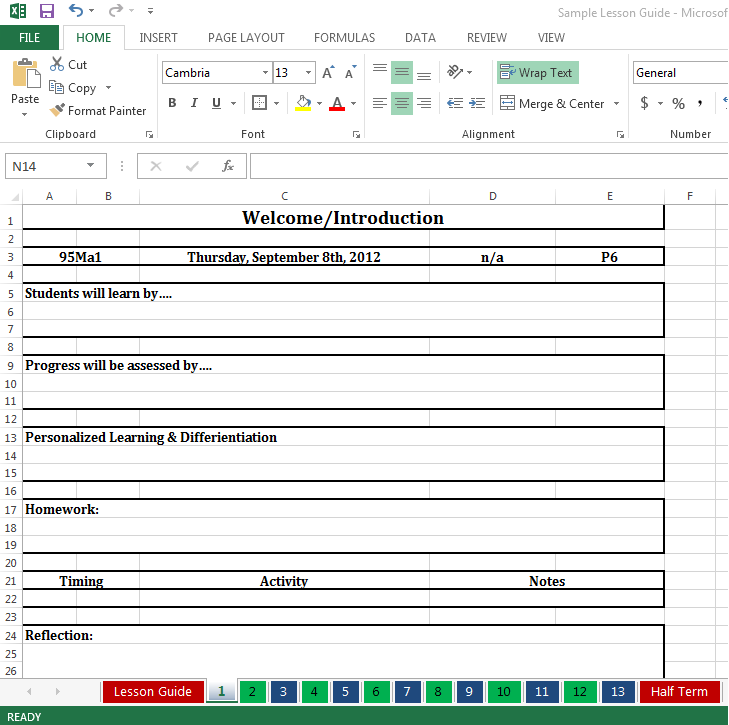
It has been three days of school and every minute of my time (other side of sleeping, cooking, eating and being on the bus) has been dedicated to lesson planning.  Each school does their lesson planning differently; requiring more details on the activities, methods of assessment and homework. 

I personally like seeing an overview of the half term, term, semester or year and how many lessons I have for each topic.  I would also prefer to have the lesson listed out with teacher and student notes and the timing for each lesson.  Placing all of this information in one document that is easily editable and changeable also helps for those last minute changes and modification.

In the excel document I have the first tab that lists the lessons in order of their appearance and organized by the week.  This tab includes the title, concepts covered and the homework given.  Using this tab I am able to quickly determine what my students have learned and what they will be learning and approximately how many lessons/weeks/terms it will take them to complete the required material.  Overall, this is the "bigger picture" portion of my lesson guide.

The next and all subsequent documents are the individual lesson plans.  According to my academy these are the required lesson planning sections (or as I have learned so far) just in a different order.  I have colour coded all of the tabs to which periods of the day I will see the students.  For example in this lesson I see the class two times a week so every other tab is blue to represent Period 6 while the other tabs are green to represent Period 2.  I also have a blank "Half Term" tab within the worksheet so that it separates the half terms nicely - this is just for esethics!

An aspect of lesson plans that many teachers do not complete often is the "Reflection" portion of the lesson.  In Teacher's College I was informed to complete this section after the lesson and once you have had the opportunity to take a look back on your lesson.  I find this component is easier (and I am less likely to forget) if I complete this during the "independent work times" in class.  Notes such as the student's behaviours, what we covered, what is left to be covered, notes for future lessons, and other information is always important to keep track. 

Here is my most recent lesson guide - if you would like a copy, feel free to email me and I can send you the Excel file.  I hope you enjoy the images and the ideas behind my lesson plan guide.


Monday, September 3, 2012

SmartBoard Tips for the Beginner

I made it through the first day.  Well, the first training day.  Other than it being total and utter chaos, it went alright.  Although reflecting on the experience, I have realized that a lot of it went over my head.  I feel that I am no where closer to understanding what I will be teaching and what my expectations are than yesterday.  But, I did receive the opportunity to attend SmartBoard training today, and I have learned many new tricks with the latest version (11).

The first neat trick I learned was that using the magic pen you can now have disappearing lines, a magnifying glass or a spotlight!  No more using the always apparent toolbar on the side!  All you need to do is open up SmartNotebook, select the pen, then the magic pen and then follow of the these three steps:
  • Draw whatever you would like - the pen marks will disappear in approximately 7 seconds.  This is great for times where you need to point out an important term, fact or image but do not want to have your ink marks left (and do not want to bother to erase them).
  • Draw a circle - the circle will then turn into the spot light.  Moving the spotlight around the page will allow you to highlight various areas of your screen to the audience and focus their attention on that portion.  The size of your spotlight will depend on the size of the circle you draw.
  • Draw a rectangle - yes, you guessed it!  Drawing a rectangle will create a magnifying glass over that portion of the image.  For the best results, make sure to draw a small rectangle.
Final fun fact for SmartBoard of the post is that SmartBoard is actually a Canadian company.  The company "Smart Technologies" was founded in Calagary, Alberta in 2009.  Want to learn more about this amazing Canadian company?  Check out this link for their company's website.

Hope this SmartBoard tip will help you get started on your own SmartBoard creations!  I will keep you posted on mine as I develop them for all of my Math classes this year.  As I am fortunate enough to have a SmartBoard in the classroom I will be teaching in, I expect to be making many fun and interactive SmartBoard

Sunday, September 2, 2012

Tomorrow it all Begins

Tomorrow morning will be my first official day as a teacher.  My five years of post-secondary education has said to prepare me for this, but I do have to admit that I am still kind of worried.  Although tomorrow is a training day, school does not start until Wednesday, I am a bit unsure on what to expect.

I am looking forward to this new adventure, but there will be a lot of "firsts" tomorrow.  Firstly, this will be the first time I will be taking the bus to the school I will be working at and the first time I will be relying on the bus to get me there.  This will be the first time I will be an official teacher, and the first time I will be preping for the school year ahead of me. 

My nervousness won't keep me up tonight, but is always in the back of my mind.   Teacher's college and my practicum experiences (including Co-op throughout my ugrad) has provided me with the experiences for being in the classroom, not so much starting and intially creating the classroom rules and boundaries.  It is my responsibility to go into the classroom and ensure that it is a safe and positive place for all students to learn.  Am I up for the challenge?  Of course - I figure that the first class or so may be difficult, but after the first few classes I will be an old pro at it.

For the bus I can either get the 7:30am bus or the 8:00am bus.  The earlier bus allows me to be at my school for 8:00am whereas the latter brings me to work at 8:25pm.  As I am required to be there for 8:30am tomorrow morning, I think I will play it safe and catch the earlier bus - bringing a book or something with me to pass the time.

Overall, tomorrow will be an interesting day - a day I am definitely looking forward to.  Tomorrow I will officially be a teacher, preping for my first classes and setting up my own classroom!

Saturday, September 1, 2012

Flying High

There are so many different ways to book air plane tickets, through a Travel Agent, online from the airline, online through a third party, etc.  With so many different outlets of tickets and prices how do you choose the best ticket?  How do you know it is the cheapest ticket?

How did I get over to the United Kingdom - through a lot of conversations and websites we selected Air Canada and Iceland Air.  We booked through the Iceland Air airline website.

Leaving Toronto Pearson Airport, we flew domestically with Air Canada to Halifax.  This flight was an hour and a half in the air.  The bonus of flying to Halifax first is that it is domestic and therefore we were not required to arrive to the airport until 90 minutes before take-off.

After our journey to Halifax, we transfered to an Iceland Air plane and then took off for Iceland.  The journey, although a bit longer than the first flight, totally three hours and forty-five minutes.  Although the flight was not that long, the time change pushed us ahead four hours. 

Once we landed in Iceland, the two hour and forty-five minute layover was long but it gave us time to walk around and be off of an air plane.  Getting back up in the air, Iceland Air took us then to Manchester for two and a half hours with an hour time change.  Landing in Manchester, we collected our baggage and moved forward in our travels to Cleethorpes.

Why did we take such a round-about way of getting across the pond?  Travelling with Iceland Air we were able to have two free checked bags and one carry-on.  The price?  When we flew, it was $655/person (including taxes).  All of the other airline companies allowed one checked bags.  The additional bags varied in price.  After looking at the amount of stuff we wished to bring over with us (although I am sure if required, we would have fit it all into one suitcase), we felt this would be our best choice.

Our next trip we will probably focus on price and let that determine our flight, but to live comfortable with our things from Canada we decided two bags trumped the price of the flight.  Best of luck picking the best flight for you!

Friday, August 31, 2012

Visa - Not the Credit Type

Whether you are traveling or working in a new country you need to have a visa.  Each visa is unique and has their own obstacles and requirements to be granted, but I would have to say I am a fan of the Youth Mobility UK Visa as thatis what I applied for (and received).

Here is a bit of information on the Tier 5 Youth Mobility Visa:
  • Allows persons for Australia, Canada, Japan, New Zealand, Monaco, Taiwan and North Korea
  • You must under 31 years of age; you have no children under 18
  • Grants you the ability to live in the UK for 24 months either working or studying
  • This visa does not require a work permit to be present
  • You can enter the country as many times as you would like over the 24 months
What do you need to apply?
  • Passport showing your age (under 31) and that you are from one of the seven countries listed above
  • Proof that have access to at least £ 1600 in your bank account
  • A passport picture of you (follow the Canadian guidelines for the restrictions and you will be OK!)
Hints to applying?

Do it as early as possible - you have the option of putting your own start date on your visa, so you can apply early and get everything sorted out.  There are also a few questions on the application that you may not know the answer to.  You can save your application and
Renew your passport - see if you can renew your passport before applying for your visa.  Keep in mind that your passport is not valid if it is within six months of its expiration date; so if you are within one year (for Canadian passports) you can renew and get another five years! 
Show up early for your Biometrics Appointing (Toronto) - although you are scheduled for a time, you can show up any time before your scheduled appointment and get in line.  This means that if you have a 4:30pm appointment, you can come in the morning and get a higher spot in line.  The wait times at the Toronto office are crazy long, so I would suggest going early and having the possibility of getting in (and ultimately out) earlier.

Thursday, August 30, 2012

Welcome

Exactly 48 hours ago, I boarded a flight from Toronto International Airport bounded for Manchester, UK.  Not my final destination,  I would then board a train and head on the three hour trip to my new life in Cleethorpes UK. 

I am a recent graduate from Queen's University and the University of Waterloo (just finished this June - woot!) and I accepted a position teaching at Cleethorpes Academy in Cleethorpes, UK.  Yes, this means that I needed to pack up my life and move to a new city in a brand new country.  Fortunately my partner accepted his position at the sister school and has moved here with me - so I am not completely alone.

So this is a blog, for me to keep track of all of my advice, thoughts and experiences to share with those who may be interested in (or are) coming over seas to pursure their teaching career.  What a learning curve that lies in front of me, I am glad you will be sharing it with me.